The Frontier Diagnostic
Which profile comes back most often in your decisions?
Twelve statements about how you actually work with AI, based on your recent decisions. Answer honestly: three minutes, no sign-up, and nobody sees your result unless you choose to share it.
The questionnaire runs entirely in your browser: your answers are neither sent nor stored.
The three zones (Conservation Zone, Dynamic Mastery Zone, Delegation Zone) are not plotted here: they do not depend on how much you use AI, but on where a given decision sits relative to your limits of knowledge and your Human Frontier.
Your declared underlying tendency
A declared underlying tendency: the profile that comes back most often in what you say about your decisions, from one subject and one moment to another. It changes over time, and says little about what you will do on a specific decision.
A profile is read over several decisions, never a single one: it varies with the subject, the context, fatigue and pressure. A Conscious Navigator may choose Defensive Retreat on a given decision.
1I use AI on questions I could not answer on my own: a field, a method or a subject I do not master.
2I make a decision with the help of AI without first asking myself: can I explain and defend this decision without referring to “AI said”?
3In my recent decisions, I used AI only for things I could have done just as well without it: rewording, formatting, summarising what I already knew.
4When an AI output goes beyond what I can check myself, I notice it and pause before going on.
5When an AI output takes me somewhere unfamiliar, I follow it further instead of bringing the question back to what I already know.
6When I work on a subject with AI, I know where my own understanding of it stops: the point beyond which I could no longer explain the reasoning myself.
7For my recent AI-assisted decisions, I can say which parts I understand myself and which I am taking on trust.
8I use AI to discover options, analyses or sources I would not have found on my own.
9I only discover that a point was escaping me when someone asks me what it rests on.
10When a task takes me outside my area of expertise, I leave AI aside and stick to what I know.
11I start using AI on a subject without asking myself whether I will be able to judge the answer.
12When AI suggests a path I had not considered, I set it aside before examining it.
What next
Three ways to go on
The book
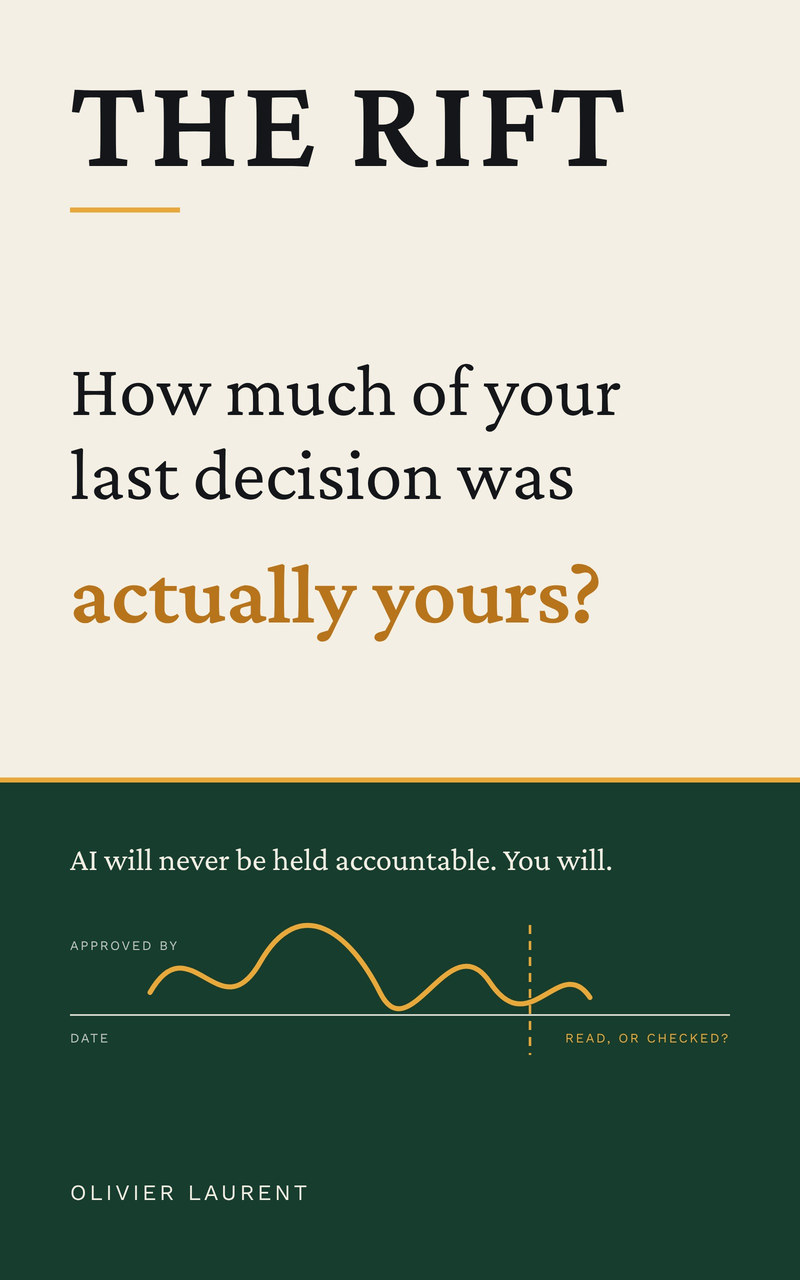
The Rift
Your underlying tendency says little about what you will do on a specific decision. The book takes one decision and follows it sentence by sentence: where your frontier lies, why you do not feel it when you cross it, and how to take back control before you sign.
On your own · self-paced · in preparation
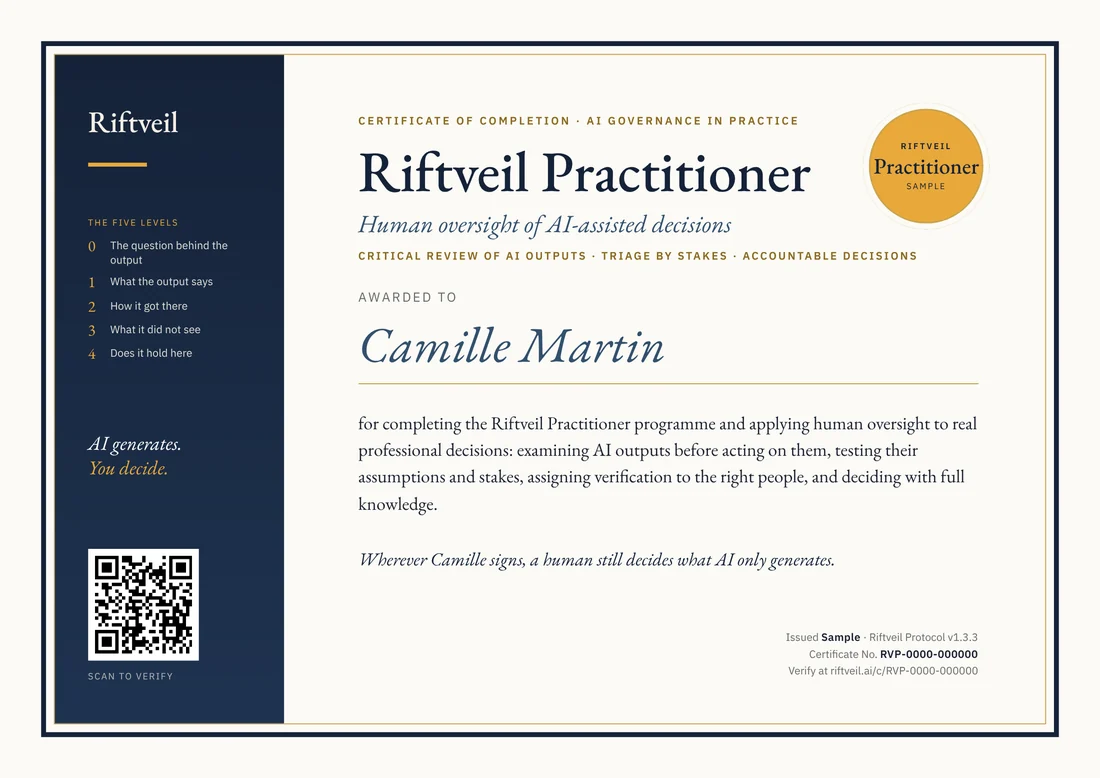
Riftveil Practitioner
Five decisions you would take anyway, this time examined and followed up in Riftveil.
A certificate of completion in your name, numbered, that anyone can verify online.
Newsletter
Stay in the loop
New writing, Riftveil releases, sector editions.