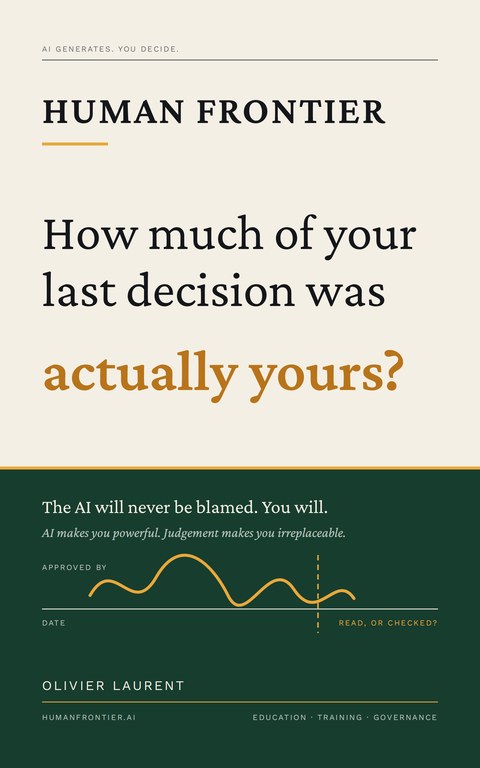
Cover of Human Frontier · How much of your last decision was actually yours? by Olivier Laurent
The book · Olivier Laurent

Human Frontier

How much of your last decision was actually yours?

This book will not tell you to be more careful. You already are. It is about the ten seconds before you press send, when an AI output reads well and your name goes at the bottom, and it gives you a method so that your signature rests on what you checked, not on what sounded right.

Read chapter 1 (PDF)

  • Kindle edition · available soon
  • In English and French

Why read this book

  1. It does not ask you to be more careful.

    Lawyers and consultants, in professions built on verification, have filed or delivered citations that did not exist. Chapter 1 shows why care is not enough: it is aimed at the content of what you read, while what has broken is the feeling that you understood it.

  2. It separates reading from checking.

    A fluent output removes the “wait, I’m lost” signal without filling the gap. The book gives you three signs you can spot from the inside in seconds, and one plain test: can you explain and defend the decision without falling back on “the AI said so”?

  3. It holds up under a real deadline.

    Three criteria set the stakes in about a minute; the stakes then set how deep you go. Once the levels are familiar, a moderate-stakes report takes most people well under twenty minutes. It is built for Friday afternoon, not for unlimited time.

  4. It leaves a record, not an impression.

    Six lines kept after the decision show what was checked, by whom, and what was still open. When a decision is questioned later, that record is what lets a bad outcome from a sound process be seen for what it was, rather than a signature given because the surface was smooth.

What the book gives you that the site does not

The site shows you the frontier and places you in three minutes. The book gives you the whole method, the reasoning behind it, and the cases that show it at work.

  • Four ways to place yourself, on your own.

    The ten-second check before you sign, the ten-minute test on a recurring task, the three signs that you have crossed the line, and the twelve questions at the end of chapter 4 that count, case by case, how often you have already crossed your Human Frontier.

  • The five levels, each with a worked case.

    A market entry, a hire, a vendor choice, a branch closure: every level shown on a real sentence, and the whole sequence runnable on paper with no AI system involved.

  • Triage by stakes, and the decision log.

    A three-paragraph price rise that turns out to be critical in sixty seconds; the “escalate on doubt” habit; then the six lines that say who verifies what, and the three honest endings for any question: answered, assigned with a date, or parked with a reason.

  • Why the model cannot check itself.

    What the research on self-correction actually found, the 64.5 % blind spot, the uncertainty models do not volunteer, “persuasion bombing”, and what “external” means, precisely.

  • Three rooms, and a fourth that is ninety-five words long.

    A hire, a platform purchase, a branch closure: three AI outputs without a single false fact, three decisions that change. Then the routine note that deserves two minutes and no more.

  • Making it survive a team, and answering for it.

    The rule that fits in one message, author before reviewer, a thirty-day pilot, five numbers worth tracking, the four objections you will hear and how to answer them; then the audit committee’s question, and what a record does and does not give you.

  • Back matter worth keeping to hand.

    Riftveil Lite, five questions on one page to print and share (CC BY 4.0); the four absolute rules; a complete report, annotated start to finish; a glossary; every source cited.

Want to place yourself first? Take the diagnostic

Extract · chapter 1 of 12

Chapter 1 · The certain risk

The risk nobody talks about has a name, and this chapter gives it one: automation bias with a human signature. You will see why it catches conscientious professionals first, two documented public cases, and a three-step check that fits into the ten seconds before you sign.

It stands on its own.

Read chapter 1 (PDF)

Twelve chapters, three parts

Part I · The frontier

  1. 1The certain riskRead now
  2. 2Two frontiers, three zones
  3. 3Reading is not checking
  4. 4Four profiles; one of them is you

Part II · The method

  1. 5Decision-checking, not fact-checking
  2. 6The five levels
  3. 7Triage by stakes
  4. 8The decision log: who verifies what
  5. 9Why the model cannot check itself

Part III · The practice

  1. 10Three rooms
  2. 11Making it survive a team
  3. 12Governance, plainly

Back matter: Riftveil Lite · The four absolute rules · A complete report, start to finish · Glossary · Sources · About the author

“The question is never whether the AI is good enough. It is whether you are still in the loop, or only in the signature.”

Chapter 1

About the author

How this book was written

This book was written the way I ask people to work with AI.

I have been working on this project since the summer of 2024, giving it my evenings, my weekends and my holidays. It has evolved with me: my observations, my impressions, my mistakes, my findings, and the evolution of the models themselves. The research, the thinking and the conceptual work are mine, as is the Human Frontier model.

I am not a writer and I do not claim to be one. To get from my notes, my instructions, my paragraphs and hundreds of exchanges to a clear text, I worked with AI. The final shaping of the text owes it a great deal. Every sentence was then reread, challenged and corrected. I can explain it and defend it without falling back on “the AI said so”.

I am an advocate of AI. My aim with this work is to help people use it responsibly. AI assists; it does not replace. And it is the human who answers for what it produces.

Written with AI. Arbitrated by its author.

Olivier Laurent · About the author

Open the last AI-assisted document you approved. Could you write down, from memory, what you checked in it? Chapter 1 starts there.

Read chapter 1 (PDF)

Kindle edition · available soon

Stay in the loop

New writing, Riftveil releases, sector editions. No schedule, no filler.

Your address is kept by our email service, EmailOctopus, and used for nothing else. Unsubscribe with one click. See the privacy note.

Next

Training

Human Frontier shows where your own judgment stops. Riftveil gives the method for what comes next.

See training